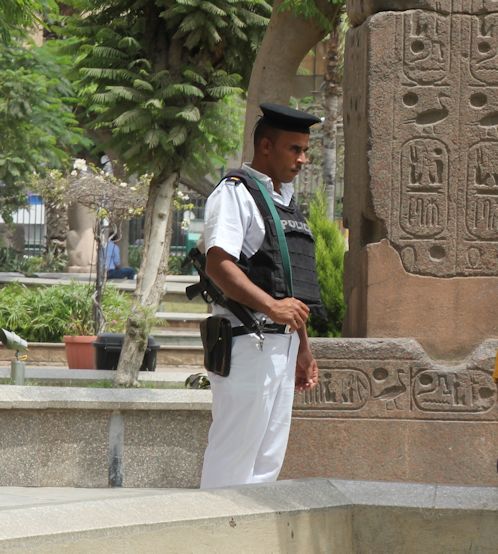
There is a heavy police and military presence in Egypt. We saw more armed personnel here than in all the countries we have visited combined! The police seem to wear white uniforms, while the military were in black. Along the roadways there are frequent "checkpoints" where guards with rifles are stationed behind barricades or on roofs of buildings. Several times our excursion coaches were stopped so that dogs could walk around the bus or mirrors were used to check for contraband underneath the bus.
Our excursion buses to Luxor and Cairo were accompanied by police escorts and there were armed security guards on many of the buses. While we had lunch on a boat cruising the Nile River, there were 4 police boats surrounding us. This heavy police presence seems to be a result of recent terrorist activity, concern about violence against tourists, and the close proximity to other Middle Eastern countries with civil unrest. While it was comforting to know that security was a top concern, it was also somewhat intimidating to see so many guns around. Below are some photos Rick took of police and militaryin Egypt.
Sunday, April 22, 2018
Cairo, Egypt
From our dock in Alexandria, we road 3 hours each way to Cairo to see the Egyptian Museum and Great Pyramids of Giza. A police escort accompanied about 15 coaches of Viking passengers to Cairo. Just like in other Egyptian cities, there was a heavy police presence along the roadways and armed security guards rode on several of the buses.
The Cairo Museum contains a wonderful collection of ancient Egyptian artifacts. There are statues of pharaohs and gods, mummies, painted wooden coffins, stone sarcophagi, paintings on papyrus, jewelry, and the entire King Tut collection. Although photos of King Tut's gold burial mask were prohibited, you will see the alabaster box that held the canopic jars containing his lungs, stomach, liver and intestines, which was then put into a larger gilded wooden box. The life-size statue of King Tut was found guarding the entry to his tomb.
After an entertaining lunch on a boat cruising the Nile River, we drove to Giza to see the largest pyramid in the world and the only remaining structure of the original "seven wonders of the ancient world." The Great Pyramid of Giza was built between 2589 and 2504 BC for King Khufu (Cheops) during the Old Kingdom period. The pyramid is very near the city of Giza and had many vendors selling merchandise and camel rides. After seeing the Pyramids, we went to see the sphinx, which has lost most of its facial features.
Ancient Egypt is generally divided into 31 dynasties, running from 3100 to 300 BC. Pyramids were built for Old Kingdom pharaohs, while later rulers were buried in tombs dug into rock in the Valley of the Kings. King Tut ruled from 1332-1323 BC, considered the New Kingdom.
The Cairo Museum contains a wonderful collection of ancient Egyptian artifacts. There are statues of pharaohs and gods, mummies, painted wooden coffins, stone sarcophagi, paintings on papyrus, jewelry, and the entire King Tut collection. Although photos of King Tut's gold burial mask were prohibited, you will see the alabaster box that held the canopic jars containing his lungs, stomach, liver and intestines, which was then put into a larger gilded wooden box. The life-size statue of King Tut was found guarding the entry to his tomb.
After an entertaining lunch on a boat cruising the Nile River, we drove to Giza to see the largest pyramid in the world and the only remaining structure of the original "seven wonders of the ancient world." The Great Pyramid of Giza was built between 2589 and 2504 BC for King Khufu (Cheops) during the Old Kingdom period. The pyramid is very near the city of Giza and had many vendors selling merchandise and camel rides. After seeing the Pyramids, we went to see the sphinx, which has lost most of its facial features.
Ancient Egypt is generally divided into 31 dynasties, running from 3100 to 300 BC. Pyramids were built for Old Kingdom pharaohs, while later rulers were buried in tombs dug into rock in the Valley of the Kings. King Tut ruled from 1332-1323 BC, considered the New Kingdom.
![]() |
| Outside the Cairo Egyptian Museum |
![]() |
| wooden coffins containing mummified body of King Tut |
![]() |
| collection of stone sarcophagi and mummy cases |
![]() |
| Great Pyramid of Giza - build for King Khufu (Cheops) from 2589-2504 BC |
![]() |
| 3 pyramids at Giza |
![]() |
| Sphinx at Giza |
![]() |
| alabaster container that held canopic jars containing removed internal organs of King Tut |
![]() |
| statue guarding the tomb of King Tut |
Thursday, April 19, 2018
Sharm El Sheikh, Egypt
Sharm, as it is called, is a resort city located on the southern tip of the Sinai Peninsula along the Red Sea. It is known for its beaches, casinos, coral reefs and shopping. We explored the Sinai desert in 4 wheel drive Jeeps, stopping at the Nabq National Park, the Wadi Karayza, and a Bedouin camp.
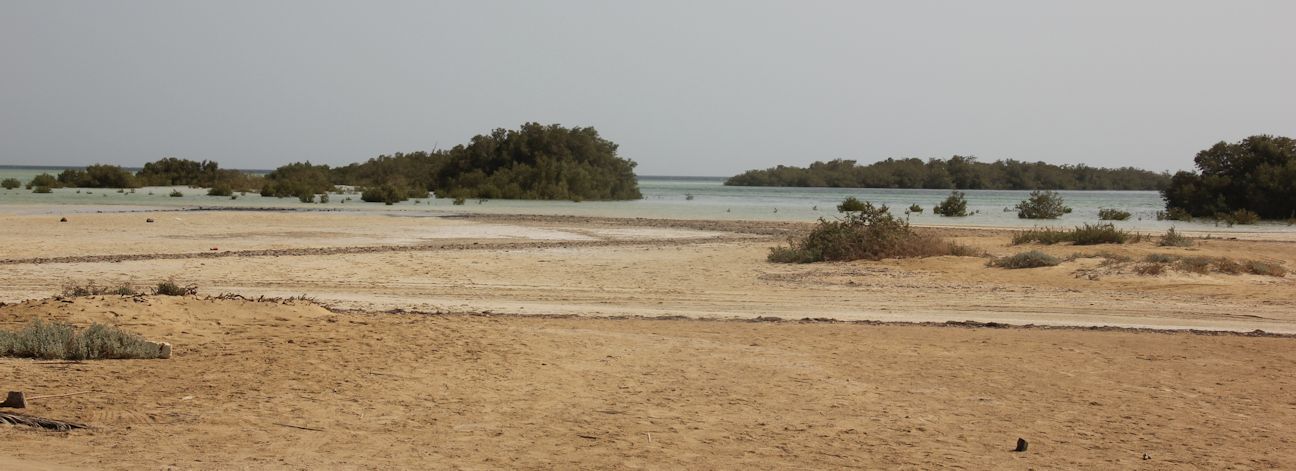
Nabq Park has a mangrove "forest" that is able to grow vegetation in the salty water. The park is acres of sand dunes, turquoise water of the Red Sea, and has a ship wreck near the coral reef. This is said to be a great location for snorkeling. Next we drove for 40 minutes through the open canyon called Wadi Karayza, which is flat, sandy, and has little vegetation. We stopped to see an acacia tree, which has long, sharp thorns and is able to survive on little water. The crown of thorns that Jesus wore while being crucified was made from this tree. Finally, we stopped at a Bedouin camp in the desert for sweet habak tea and freshly grilled flat bread. Young boys brought their one-hump camels (dromedaries) out for us to ride. You really have to hold on and lean back when the camels stand up and sit down! We were entertained by a female belly dancer and a male who twirled a cape while dancing. A really enriching cultural experience in the Sinai desert.
| Sand and mangrove plants at Nabq National Park |
| ship wreck off the reef at Nabq Park |
| Desert terrain at Nabq Park |
| stopping in Wadi Karayza to look at the acacia tree |
| One-hump camel (Dromedary) |
| Grilling flat bread at the Bedouin camp |
| male dancer twirling fabric |
| watching entertainment at the Bedouin camp |
| belly dancer |
| at the Bedouin camp |
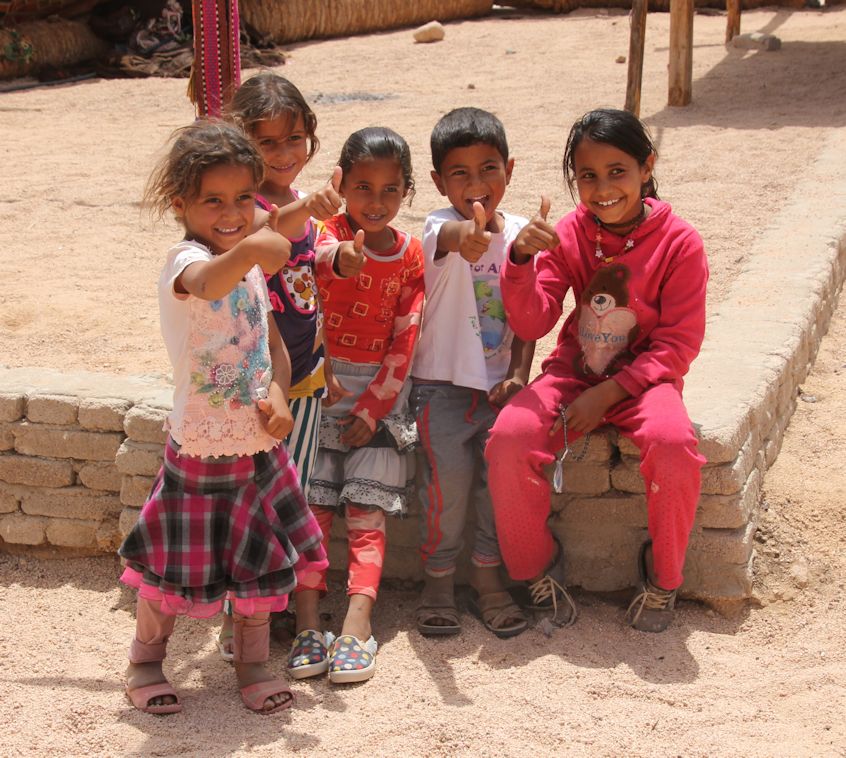
| Bedouin kids hamming it up for the camera |
| Bedouin home in the desert -- notice the satellite dish! |
Luxor, Egypt
After docking in Safaga, we traveled 3 hours by coach to Luxor to see the Temple of Karnak and the Valley of the Kings. We had an armed security guard onboard the bus and passed many police check points along the way. Initially after leaving Safaga, the terrain was very desolate -- sand, rocks, hills, nothing green. After driving for 1.5 hours, we came to the agricultural area of central Egypt. Many small farmers were harvesting wheat and sugar cane by hand, transporting it by mule cart. The crops are grown near irrigation canals and the people have their homes along the canals.
The Temple of Karnak (meaning "The Most Selected of Places"), built between 2055 BC and 100 AD, is the largest religious building ever constructed (200+ acres). It features an avenue of ram-headed sphinxes, the Hypostyle Hall with 134 tall columns, 2 obelisks, statues, chapels, temples and a lake. You can still see hieroglyphs carved in the stone and paint at the top of the columns. We spent an hour exploring the grounds -- it was about 100 degrees.
After a buffet lunch at Jolie Ville resort, we then crossed the Nile River to go to the Valley of the Kings. The terrain is sandy hills, the climate is very dry. You can see why this was a perfect place to hide and preserve mummified pharoahs. There are thought to be 63 tombs here, 19 of which are accessible. We visited the tombs of King Tut, Rameses IX, Rameses IV, and Rameses VII. The only thing remaining in the small tomb of King Tut is his mummified body, which was discovered in 1923 by Howard Carter. The golden mask and other artifacts buried with him are now on display in the museum in Cairo. The other tombs were larger and had beautiful painted artwork and hieroglyphs on the walls and ceilings. It was amazing how well the colors have remained over thousands of years.
The Temple of Karnak (meaning "The Most Selected of Places"), built between 2055 BC and 100 AD, is the largest religious building ever constructed (200+ acres). It features an avenue of ram-headed sphinxes, the Hypostyle Hall with 134 tall columns, 2 obelisks, statues, chapels, temples and a lake. You can still see hieroglyphs carved in the stone and paint at the top of the columns. We spent an hour exploring the grounds -- it was about 100 degrees.
After a buffet lunch at Jolie Ville resort, we then crossed the Nile River to go to the Valley of the Kings. The terrain is sandy hills, the climate is very dry. You can see why this was a perfect place to hide and preserve mummified pharoahs. There are thought to be 63 tombs here, 19 of which are accessible. We visited the tombs of King Tut, Rameses IX, Rameses IV, and Rameses VII. The only thing remaining in the small tomb of King Tut is his mummified body, which was discovered in 1923 by Howard Carter. The golden mask and other artifacts buried with him are now on display in the museum in Cairo. The other tombs were larger and had beautiful painted artwork and hieroglyphs on the walls and ceilings. It was amazing how well the colors have remained over thousands of years.
| Town on the way to Luxor |
| Harvested crops are transported by donkey carts |
| the agricultural area of central Egypt; mainly wheat fields |
| Approaching the Temple of Karnak in Luxor |
| looking down the central aisle |
| inside the temple |
| colors from 4000 years ago can still be seen on the columns |
| carvings and hieroglyphs on the walls |
| columns in the Hypostyle Hall |
| 1 of 2 obelisks in the Temple |
| The Nile River |
| Approaching the Valley of the Kings in Luxor |
| Tombs were dug down into the rocky hills |
| No photos allowed inside; only his mummified body remains |
| Painted walls in the tomb of Rameses IX |
| Decorated walkways leading to the sarcophagus |
| Beautiful painting on the ceiling of a tomb |
| sarcophagus carved with hieroglyphs |
Subscribe to:
Posts (Atom)